
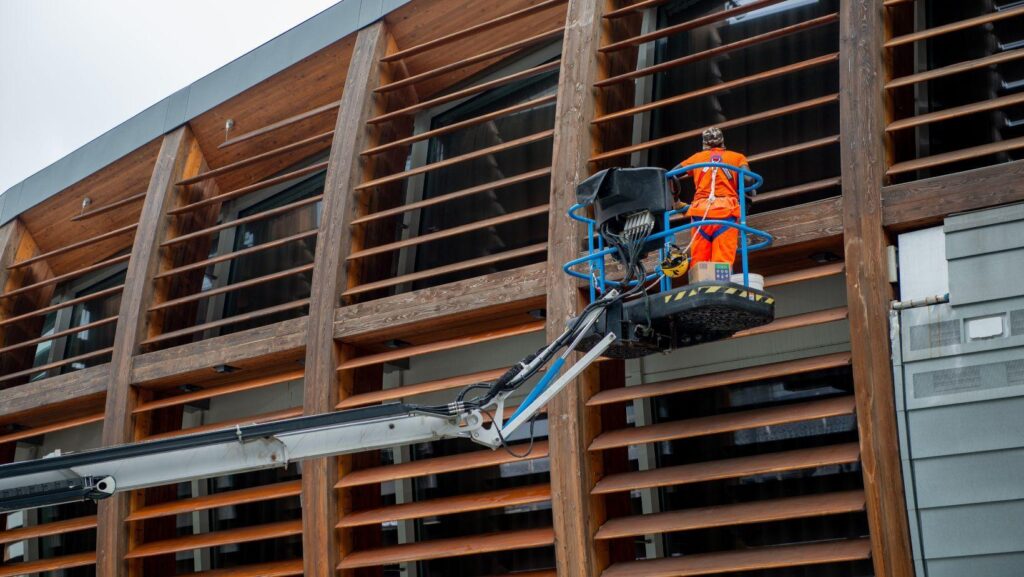
Aerial platform lift is a broad label covering machines that behave nothing like each other. A scissor lift and a truck-mounted boom both raise people, and beyond that they share almost no useful characteristics.
Rather than list every type, it is quicker to run through four questions. Each one rules whole families in or out, and by the fourth you are usually down to a single answer.
Question One: Is the Work Directly Above the Machine?
If the machine can stand under the work and go straight up, you are in vertical lift territory: personnel lifts, mast lifts and scissor lifts.
These are simple, stable, quick to set up, and give a large working platform on scissors. They cost less to hire than boom machines and are ideal for ceiling services, lighting grids, racking and internal fit-out.
If anything sits between the machine and the work- a fence, a planted bed, a canopy, a roof edge- vertical lifts are out. That single question eliminates about half the fleet.
Question Two: What Is the Ground and Where Is the Job?
Indoor work on a finished floor calls for electric machines with non-marking tires and no exhaust.
Outdoor work on rough or sloping ground calls for a rough terrain machine with Four Wheel Drive, or a tracked spider lift where access is narrow and floors are delicate. Work reached from a road or hardstanding, particularly at height, points at a truck-mounted platform, which drives to site, sets on outriggers, and needs no site tracking at all.
Choosing an aerial platform lift without settling this question is how machines arrive that cannot cross the yard they were delivered to.
Question Three: How High, and How Far Out?
Height alone rarely decides it. Outreach usually does.
Articulating booms bend around obstacles and reach over parapets, trading some outreach for that flexibility. Telescopic booms give the longest straight-line reach and suit open sites with a clear approach. Truck-mounted platforms cover the tallest work in the fleet and combine road-legal travel with substantial reach, provided there is a firm setup position within range.
The load chart settles the argument in every case, since both height and outreach shrink as basket load rises.
How Often Will the Aerial Platform Lift Move?
Machines differ enormously in how quickly they move.
Self-propelled booms and scissors travel between positions under their own power, which suits work spread across a site. Truck-mounted machines stow, drive and redeploy in minutes, which suits work spread across a town. Trailer and spider lifts need setting up again each time, which is fine for a couple of positions and slow for twenty.
|
Type |
Best suited to |
Main limitation |
|
Mast and personnel lift |
Indoor maintenance at modest height |
Vertical only, single occupant |
|
Scissor lift |
Continuous work above a clear floor |
No reach around obstacles |
|
Articulating boom |
Reaching over or behind obstructions |
Outreach traded for flexibility |
|
Telescopic boom |
Long straight reach on open sites |
Needs a clear approach path |
|
Truck mounted platform |
Tall work reached from a road or yard |
Requires a firm setup position |
|
Spider or tracked lift |
Narrow access and delicate floors |
Slow to reposition, lower capacity |
Where People Get It Wrong
Two mistakes account for most of the trouble.
The first is choosing on height alone and discovering the machine cannot get past an obstacle. The second is choosing on price, hiring a vertical lift for work that turns out to need reach, then hiring a boom the following week anyway.
Both are avoided by walking the job once and answering question one honestly.
Narrowing the Fleet in Four Answers
Work through the questions in order, and the shortlist forms itself. Vertical access over clear floors goes to a scissor or mast lift. Obstacles in the way move you to an articulating boom. Open ground and long reach favor a telescopic machine. Tall work reached from a road, with no appetite for tracking across a site, points to a truck-mounted platform. Suppliers such as Blade Platforms will match a type to a site rather than to a height figure, so describe the ground, the obstacles and the number of positions when you enquire and let the machine follow the job.