
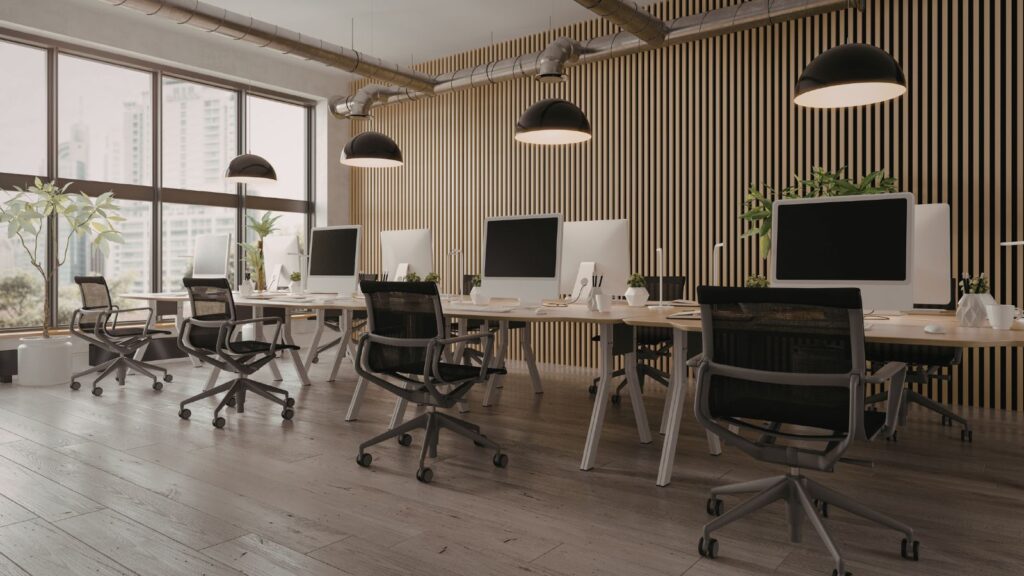
For a few years, “office” became shorthand for cost cutting. Teams went remote overnight, leases were shed, and many leaders promised they’d never sign another long contract. Yet the story has matured. Hybrid work is now normal, but so is the realization that work still needs a place to happen well—especially the kind of work that depends on trust, fast feedback, and a shared sense of momentum.
Professional office space isn’t just a nicer backdrop for Zoom calls. It’s a tool for shaping how people collaborate, how decisions get made, and how a company is perceived by clients and candidates. When you look at it through that lens, the question changes from “How little space can we get away with?” to “What space helps us perform?”
If you’re exploring options like long-term office rentals, the most useful frame is business value over time: productivity, retention, client confidence, and risk reduction—not simply rent per square foot.
Office space as a performance multiplier
Collaboration that actually scales
Slack threads and video calls move information; they don’t always build alignment. In-person time is disproportionately valuable for complex, ambiguous work: planning cycles, product discovery, onboarding, and cross-functional problem solving. A professional office gives those moments a reliable home, with meeting rooms, whiteboards, and the small “collisions” that help teams unblock each other.
The payoff tends to show up as cycle-time improvements: fewer handoffs, clearer ownership, faster decisions. Even a modest reduction in rework can offset meaningful portions of occupancy cost when you consider fully loaded salaries.
Culture, belonging, and the retention equation
Hiring has become more selective, and so have employees. People don’t just evaluate compensation; they evaluate the experience of working with you. A well-run office supports that experience in tangible ways: it makes onboarding smoother, helps junior staff learn by observation, and creates social glue that is hard to manufacture through scheduled calls.
Retention is where the math gets compelling. Replacing a skilled employee can cost months of productivity plus recruitment fees. If a consistent workspace reduces avoidable churn—especially among early-tenure hires—it can produce a return that dwarfs a line item like rent.
The real cost model: beyond rent
The cheapest workspace on paper can be the most expensive in practice. Leaders often undercount “hidden” costs that surface when space is ad hoc, unreliable, or poorly supported. A more complete model includes:
- Time cost: hours lost to finding rooms, unreliable Wi‑Fi, noise, or fragmented locations.
- Operational load: staff time spent managing vendors, access, mail, and meeting logistics.
- Client impact: opportunities lost when you can’t host confidently or protect confidentiality.
- Risk and compliance: data handling, health and safety, and insurance exposure.
Professional office space can reduce these categories by standardizing the environment. It also clarifies accountability: who owns the setup, the security, the maintenance, and the day-to-day experience?
There’s also a risk-management angle that doesn’t get enough attention. As companies adopt hybrid, they sometimes distribute work across dozens of informal sites: coffee shops, shared apartments, coworking day passes. That increases variability, and variability is the enemy of predictable execution.
Think about the moments that are hard to price until they go wrong: a sensitive HR conversation overheard in a café, a prototype shown on an unsecured screen, or a last‑minute client visit where you scramble for a quiet table. Professional space buys you privacy, readiness, and calm when it matters.
Hybrid work needs an intentional “home base”
Design for how your team works now
A modern office shouldn’t be rows of desks that sit empty three days a week. The most effective spaces tilt toward collaboration: project rooms, phone booths, and flexible zones that can switch from stand-ups to workshops. If people are commuting, make the trip worth it.

A practical approach is to plan around “anchor days” and team rituals. For example: product and engineering might align on two fixed days for planning and demos; sales might come in for enablement and pipeline reviews; leadership might use a consistent cadence for decision meetings. Space utilization becomes more predictable, which helps you right-size without under-serving your team.
Measure outcomes, not attendance
Mandates often backfire because they treat presence as the goal. Instead, set expectations for when in-person work creates value—onboarding weeks, quarterly planning, client workshops—and measure whether those moments improve speed and quality. Pair that with lightweight data: meeting room demand, badge swipes, and short pulse surveys on focus and collaboration.
When people see that the office is designed around their needs, attendance becomes a pull rather than a push.
A decision checklist for leaders
Investing in professional office space is usually most defensible when at least one of these is true: you’re growing, you’re rebuilding culture after rapid change, your work is highly collaborative, or you need a credible place to meet clients and partners. If none apply, a lighter footprint may be fine.
Before you commit, pressure-test three assumptions. First, workflow: what work must happen in person to be excellent? Second, people: which roles benefit most from proximity, mentoring, or secure environments? Third, brand and trust: what does your space communicate to the market?
Office decisions are rarely reversible in the short term, so it’s worth treating them like any other strategic investment. The goal isn’t to return to “the old office.” It’s to build a workspace that makes your best work easier, your team more cohesive, and your business more resilient.