
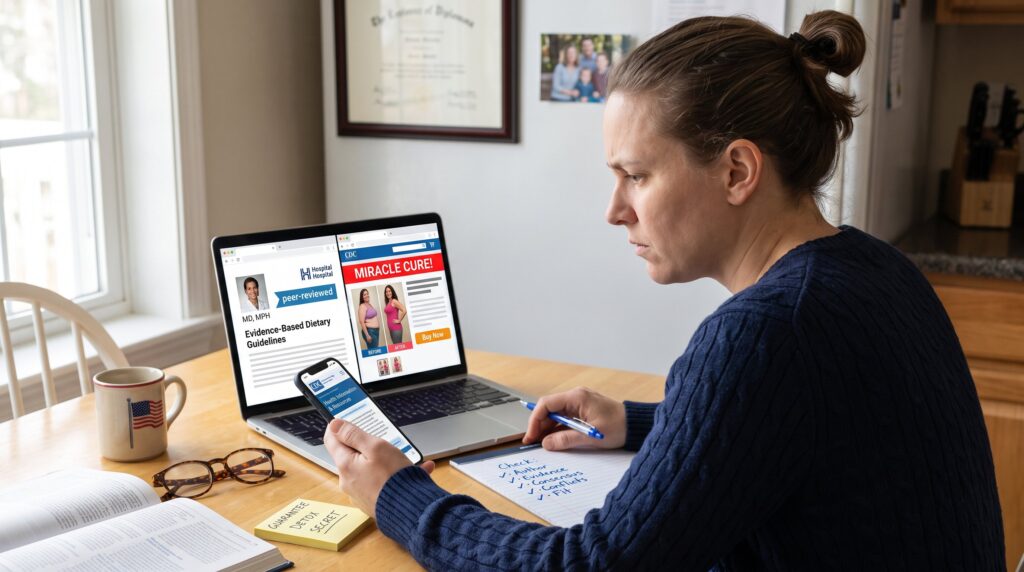
Ways to Evaluate Health Advice You Find Online is a skill readers need now. The web mixes solid guidance with dazzling claims that can harm. This guide shows clear, practical checks a person can run quickly: who wrote it, what evidence backs it, whether there’s a conflict of interest, and if the advice fits their health situation. It prepares readers to decide fast and avoid common traps without technical jargon or long lectures.
Key Takeaways
- Evaluate the credibility of health advice by verifying the author’s professional credentials and the reputation of their organization.
- Check the strength of evidence supporting health claims by looking for systematic reviews, randomized trials, and consensus from major health bodies.
- Be cautious of red flags like miracle cures, exclusive claims, heavy use of testimonials, and vague scientific language without citations.
- Assess if the advice is relevant and safe for your individual health conditions, medications, and risks before applying it.
- Identify potential conflicts of interest such as funding sources or product sales that may bias the health advice.
- Follow a simple five-step routine: verify author and source, evaluate evidence, check expert consensus, watch for red flags, and consider personal health relevance.
Check Source Credibility First: Who’s Behind The Advice?
Fact first: check the author and organization before trusting the recommendation.
A trustworthy page names a qualified author, lists credentials (MD, PhD, registered dietitian), and shows institutional backing. If a page is anonymous, sponsored by a brand, or written by an influencer with no health credentials, treat it as low-credibility. For example, a clinic page from an academic medical center will usually display authorship and reviewer names. A product landing page often shows only marketing copy.
What to verify, step by step:
- Author credentials: confirm medical or professional training and affiliation. A named clinician with hospital ties is stronger than a social post.
- Organizational reputation: prioritize government health agencies, major teaching hospitals, and professional societies.
- Editorial review: look for phrases like “peer-reviewed,” “medical review,” or an editorial board.
Practical check: open the site’s About or Contact page and note institutional addresses, licensing, or advisory boards. If credentials are absent, pause and look elsewhere.
Links that help readers find reliable health content on the same site include an overview of the site’s health coverage and pages that explain how to find articles. GoodNever provides a broader context on lifestyle content, so readers can compare standards using the site’s overview of health resources in the cluster. For a guided entry to the site’s health content, see the site’s health overview. Another useful internal resource shows how to locate specific health and wellness pieces via the site’s navigation: how to find health articles.
Evaluate The Evidence: Claims, Studies, And Scientific Consensus
Fact first: strong health claims cite rigorous evidence, not testimonials.
A reliable claim points to systematic reviews, meta-analyses, or randomized controlled trials. Lower-quality support includes single small studies, isolated case reports, or anecdotes. When a page cites research, check the study size, duration, and funding source. A 10-person trial over two weeks is far weaker than a multicenter randomized trial with thousands of participants.
Concrete steps to judge evidence:
- Identify the study type named on the page. Prefer systematic reviews and randomized trials.
- Note sample size and follow-up length: bigger and longer studies give more confidence.
- Check for disclosure of funding. Industry-funded trials can be valid, but require careful interpretation.
- Look for consensus statements from major bodies: if the American Heart Association or similar groups disagree, the new claim needs exceptional proof.
Red flags appear when authors rely on broad scientific-sounding words without citations, or when they cite a single, old study as definitive. For practical verification of what counts as reliable sources online, reputable resources outline the same checks used here. Readers can compare these criteria to external guidance on trustworthy health information to reinforce their judgment: for example, an external guide explains typical markers of reliable sources and how to weigh evidence in online health content. Find reliable sources For background on how these pieces fit together, see the wellness guide.
Red Flags In Health Claims To Watch For
Fact first: certain phrases and formats usually signal weak or deceptive health advice.
Watch these specific warning signs:
- Miracle language: “cures,” “guarantees,” “detoxes overnight,” or “works instantly.”
- Exclusive claims: “doctors don’t want you to know” or “secret remedy.”
- Heavy reliance on before-and-after photos, testimonials, or celebrity endorsements instead of data.
- Vague scientific terms used without references.
Example: a supplement page that shows three glowing testimonials, a single small trial, and a button to buy the product should be treated skeptically. In 2025 a consumer watchdog flagged dozens of such pages for overclaiming benefits based on weak evidence, a reminder that emotional marketing often fills the gap where science is thin.
Assess Personal Relevance, Risks, And Conflicts Of Interest
Fact first: even accurate advice can be unsafe or irrelevant for a specific person.
After confirming credibility and evidence, ask whether the advice applies to the person’s age, pregnancy status, chronic conditions, medications, or allergies. A weight-loss drug trial in healthy adults may not translate to someone with heart disease or kidney problems. When advice lacks details about who was studied, treat it as incomplete.
Practical safety checks:
- Applicability: does the study population match the reader’s situation? If unclear, the advice may not apply.
- Interactions and side effects: credible articles list known harms and drug interactions. Absence of this information is a serious omission.
- Conflicts of interest: look for funding, affiliate links, or product sales tied to the authors.
Concrete example: a blog promoting a new herbal tincture cites a single lab study and sells the product on the same page. That creates a direct financial conflict and increases the chance of biased claims. A transparent page notes sponsorships, separates editorial content from ads, and provides balanced descriptions of risks.
Related internal resources within the site cluster explain how to choose health services and pharmacies safely: those pages help readers apply these checks when they must act. For help choosing a clinician, see the guide on how to find a doctor. When considering medications online, compare the article to the site’s piece on safe online pharmacy.
Conclusion: A Simple Routine To Verify Health Advice Before You Act
Fact first: use a five-step routine every time before following online health advice.
A practical routine: (1) identify the author and organization, (2) find the evidence and evaluate study strength, (3) check consensus among major health bodies, (4) scan for red flags and financial ties, and (5) confirm the advice fits the individual’s health situation. This sequence filters out most risky or misleading claims quickly.
A realistic warning: even after these checks, a single web article rarely replaces a clinician’s judgment. If the advice affects prescriptions, surgery, pregnancy, or serious illness, consult a qualified provider. GoodNever’s broader lifestyle and health hub collects vetted content and tools that readers can use to compare claims across trusted articles: for context about the site’s scope and standards, readers can reference the site overview in the cluster. For readers wanting more navigation help on the site, see the page about what the site covers.
Using the five-step routine will reduce harm, save time, and help readers act with confidence rather than impulse.